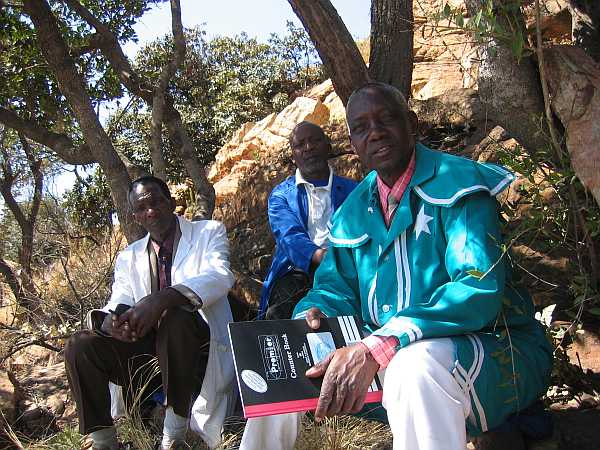
The churches which use the Koppies are Pentecostal,
Charismatic, and consist of small groups of worshippers bound to a
single inspirational leader. About 30 groups use the Koppies, and there
are probably more than 400 worshippers, clad in traditional white, and
green or blue robes, on MK West every Sunday afternoon. They use
circles, sometimes concreted, surrounded by stones for their
prayer meetings.
They practice a combination of African traditions with a deep
devotion to the Bible. Dancing, trance states, and healing are common.
Abstinence from alcohol and tobacco is required. Churches like these
represent a deeply significant example of the reaction of African
culture to the dour Christianity of the early missionaries.
In 1974 the churches ventured onto the Western Koppies, and
despite police harassment in the apartheid years, have managed to
survive, and to flourish.
The MKMC has always maintained a good relationship with the
churches, a member of the Churches sits on the MKMC, and an MKMC member
attends bi-monthly Church meetings. The history of negotiation and
compromise is an example of the meeting of two heritages - two cultures
- in making MK West a special example of a different model of
conservation.
There is a new trend of people, unconnected to these churches,
who worship on the ridges of the Western Koppies every day.
Barbara Shaw who did her MA on the churches who pray on Melville Koppies was the guest speaker at our Annual General Meeting on 16th August, 2014. Read her talk here
A Description of Beliefs
and Practices
Contents
- Historical background to the movement
- Relationship of the MK West churches with authorities
- Reasons for the churches' presence on the MK West section
- Benefit of the relationship for Melville Koppies
- Details of the MK churches
- Possible reasons why churches worship on MK West
- Tourism and the churches
- References
- Glossary
1. Historical background to
the movement
According to Dr Allan Anderson, who has done academic
research on Pentecostalism for ten years and has been involved with the
movement in South Africa for 25 years, "South Africa was one of the
first countries on the continent to receive Pentecostalism, in 1908. In
less than a century, between 10 - 40% of the population have become
Pentecostals, depending how 'Pentecostal' is defined. The 10% includes
'Classical Pentecostals' of several denominations, the largest being
the Assemblies of God, the Apostolic Faith Mission and the Full Gospel
Church of God. It also includes various new Pentecostals and
'Charismatics'. But the other 30% of the population consist of the
almost entirely Black 'Zionist' and Apostolic churches, including the
largest denomination in Africa, the Zion Christian Church (ZCC).
There are between 4 000 and 7 000 smaller church
organisations of a similar type, many being house churches which form
meaningful groups both in rural villages and especially in urban
sprawls. Almost all of these churches, like all the Pentecostal
churches, emphasize the power of the Spirit in the church, especially
manifested through healing, prophecy, exorcism and speaking in tongues.
The Pentecostal movement, including the many African churches
that have emanated from it, is not a North American imposition but
collectively one of the most significant African expressions of
Christianity in South Africa today, where at least ten million people
can be identified with a form of Pentecostalism.
The major Pentecostal denominations were mostly created by
White South Africans with a small number of foreign missionaries; but
national African leadership was not given space to emerge, eventually
resulting in secessions of independent Zionist and Apostolic churches
and increasing distance between the Black and White Pentecostals in the
same denomination. The secessions marked the beginning of the
independent African Pentecostal churches, which mushroomed from some 30
churches in 1913 to 3,000 by 1970, and to over 6,000 by 1990.
African Pentecostal churches of all kinds are concerned to
provide for holistic needs in many different ways. As Martin West
pointed out, Pentecostal churches "meet many of the needs of
townspeople which were formerly met by kin groups on a smaller scale in
rural areas."
Many forms of African Pentecostalism have liberated
Christianity from the foreignness of European cultural forms. A
sympathetic approach to African life and culture, fears and
uncertainties, and an engagement with the African world of invisible
forces, have been major attractions of the churches to people
orientated to a world of both evil and good spirits. This is
accentuated in the Black townships today, where rapid urbanization and
industrialisation have thrown people into a strange, impersonal, and
insecure world where they are left groping for a sense of belonging.
(A. Anderson, pp1 - 15)
2. Relationship of the MK
West churches with authorities
Before 1991, church groups on the Koppies faced difficulties
with the authorities. In 1991, the Voluntary association of African
Independent Churches was set up. It cooperated with the Johannesburg
Council for Natural History (JCNH) which was set up in 1959 to advise
the Council on the management of Melville Koppies, established as a
Nature Reserve in that year. In 1993 the council set up the Melville
Koppies Management Committee (MKMC) of volunteers as a joint venture
arrangement with the Council for the management of Melville Koppies.
The MKMC and AIC associations have representatives on each other's
committees. The MKMC is not concerned with the faith or beliefs of the
churches, but with the preservation and conservation of the Koppies.
After discussion with the JCNH, the churches drew up a Code
of Conduct for church members on the acceptable use of the Koppies. The
MKMC concurs with the code which was modified in April 2007 to exclude
the making of fires.
The code states that everyone will:
- Look after the animals, birds, plants, soil and rocks in
this special place.
- Keep their circles clean and also the area in a 50m
radius. Put rubbish in bags and put it in the litter bins by the road.
- Keep their circle and the area in a 50m radius weed free.
- Respect other people and the decisions of the Voluntary
Association Committee. If a leader believes the committee is not acting
correctly, he or she can appeal to the MKMC
- Send at least one representative to the AIC meeting at 11
o'clock on the second Sunday of every second month (February, April,
June, August and October)
The current chairman is Cyril Maphosa with office bearers
Levison Ncube 082 747 6737 and Kenneth Sannie 082 530 4651, among
others
3. Reasons for the churches'
presence on the MK West section
Melville Koppies is divided into three sections;
Melville Koppies Central (50ha) is a National Nature Reserve
and Heritage Site and as such has controlled access. Churches are not
permitted to worship here.
Melville Koppies East (10ha) and Melville Koppies West
(100ha) are classified generally as public open space and are open
daily from dawn to dusk.
Melville Koppies East is a long narrow strip closely
surrounded by houses. Singing and drumming would cause a disturbance to
the neighbours so churches do not meet here. However, individuals use
this section for silent prayer.
The churches meet on Melville Koppies West on the northern
slopes overlooking West Park Cemetery. This has been encouraged to
prevent the drumming from disturbing neighbours in the suburbs of
Westdene and Melville. The northern slopes also have trees and these
provide welcome shade.
4. Benefit of the
relationship for Melville Koppies
- The presence of the churches adds a measure of security
for people who walk the Koppies on a Sunday afternoon.
- The churches have been made aware of conservation and
assist with the upkeep of the Koppies.
- The aim of nature reserve is not to exclude indigenous
people from their traditional use of the Koppies but to encourage the
responsible use.
- Three church members, otherwise unemployed, are now part
of the MKMC conservation team that looks after the 160ha reserve. The
members are paid from donations raised by the MKMC for managing the
Koppies. This arrangement has benefited the Koppies enormously because
the whole reserve is now looked after.
5. Details of MK West
churches
There are 23 church groups, registered with the AIC
committee, on Melville Koppies West. The names of the groups tend to
have 'apostle', 'Zion' or 'Africa' in the names, e.g. 'Apostolic Church
in Africa, 'New Gospel Church of Zion in Africa', The Holy Apostolic
Church in Zion', Jerusalem Church of God in Zion'. Membership of the
churches range from 7 to 50 per group with a total of over 500 members.
The leaders or Bishops and the members come from the surrounding
suburbs and from other areas such as Randburg, Vosloorus, Maraisburg
and Edenvale.
They are not part of the large Zion Christian Church (ZCC).
6. Possible reasons why
people worship on MK West
It has been a traditional place of worship long before 1991
when a census was taken of the churches
They worship on Melville Koppies because it "is close to
God", according to Nhlanhla Mdluli, a church member. Perhaps the
Koppies are a reminder of the rural areas where many members originate
from. It is a place of peace and beauty away from the squalor of some
urban areas. It is a place of spiritual upliftment and appears to
contribute to emotional and mental health. Sunday afternoons are a time
of joyous celebration accompanied by singing and dancing to the steady
rhythm of drums. The services are participatory. All members have a
turn in reading the scriptures and everyone dances and sings.
The church meetings are a very important part of the social
calendar and seem to take precedence over other activities. The groups
are very caring. They take donations, all recorded in a book, and give
these to people in their circle in need of help. Their values are
uncompromising. Cigarettes and alcohol pollute the body that God gave,
therefore refrain from these activities. "If you don't like this, go
elsewhere", says Kenneth Sannie, a church member.
7. Tourism and the churches
The churches have agreed to tourists visiting their circles
with Deanna Kirby (083 266 9949), a Parktown and Westcliff Heritage
guide. Tourists may listen to part of the service in the vernacular and
join in the dancing for a while. They are then taken to another circle
and the customs are explained and questions are answered by a church
member. Tourists are expected to make a donation to the circle visited.
The aim of the visits is to promote an understanding of
different cultures and their beliefs.
9. References
Anderson, Dr Allan, 'Pentecostals and Apartheid in South
Africa during Ninety Years 1908-1998', University of Birmingham,
Cyberjournal for Pentecostal-Charismatic Research,
http://www.pctii.org/cyberj/cyberj9/anderson.html
Davie, Lucille, www.joburg,org.za 16th April 2003 article
The Code of Conduct of the Voluntary association of African Independent
Churches of Melville Koppies. August 18th, 1991 updated 2007
Various MKMC minutes
Informal discussions with MKMC and church members
10. Glossary
AIC, African Independent Churches
JCNH, Johannesburg Council for Natural History (now defunct)
MKMC, Melville Koppies Management Committee
MK, Melville Koppies